Art as therapy does not fullfill any of the functions of art. It is purely a means of allowing the individual to understand himself. It can only be of importance to the individual himself, and those who wish to study the individual's psyche.
The Creative Arts are completely depersonalized. Little remains from the individual who created it.
Archetypes exist within the human psyche that manifest themselves within the various types of art. The circle which often represent completion or wholeness, or animal figures which we have come to denote various strengths of the human psyche are examples of these archetypes. They can be seen in all cultures and have a universal meaning.
By studying these archetypes, we can come to know more about art and about the human species.
The spiritual themes represented in modern art depict a separation from the realism of art in former ages. Abstract expressionism allows one to express in pure symbolic form. This is to say--shapes and colours, instead of people and figures.
The rift between abstraction and realism can be viewed as a rift between the conscious and the unconscious. As we become more aware of the importance of the unconscious, modern art becomes more importance to us.
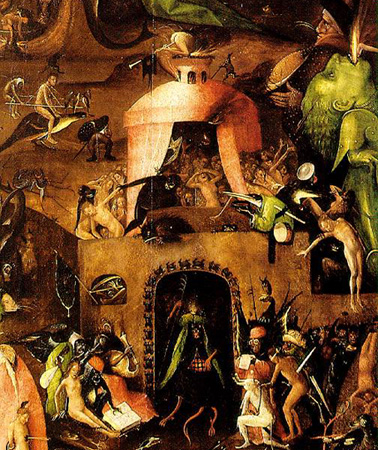
One of the most common symbols found in all cultures is the circle. This often takes the form of a mandala (Hindu for magic circle). We can see this in architecture (where sanctuaries are built as circles) the sand paintings of native indians, and even abstract symbols for God.
Animals are also an important part of the symbology of religions. Deities often take on the forms of animals in addition to their human form. We have seen Zeus manifest himself as an animal to tempt and trick one of his many female escorts. Egyptian mythology is full of them, even the eastern religions have pictured deities in animal form.
Yet these are hardly the end of symbols in religions. The crucifix is used in Christian symbology to symbolize man being fixed into the earth, but elevated towards heaven. The important thing to consider in interpretation of religious art is the context of the symbol, even more so than the symbol itself.
In order to interpret art, to extract its psychological meaning, we must learn the symbols of man, of his mythology, and of his psyche. These archetypes are the same regardless of culture or geography. These values and these symbols interpret the depth of man in the various stages of his existence.
If we can begin to understand the art which he creates, we can better understand man himself.